“When rivals fight over the corpse, the elders hide the grave. The grave shown to the crowd is not always the grave that receives the king. For a secret kept by the elders is no lie; it is a fence around the shrine”. Osofo Nii Naate Atswele Agbo
In the current chieftaincy impasses in Ga states, critics sometimes point to an empty or ceremonial coffin and conclude that a royal funeral is fraudulent, that the custom is an invention, or that the royal house is merely assuming a burial. That conclusion is a category mistake.
In Ga royal custom, where the practice is invoked, the public coffin and the actual interment are not necessarily the same thing. The public casket is a ritual and political instrument. The real body, the real grave and the real ritual sequence are protected by accredited elders and priests. To call that assumption is itself an assumption imposed from outside the custom.
Ga royal funerals are governed by customary law, oral tradition, taboo and the authority of traditional councils and royal houses. Custom is not a public autopsy. It does not require that every ceremonial object be exposed to public verification.
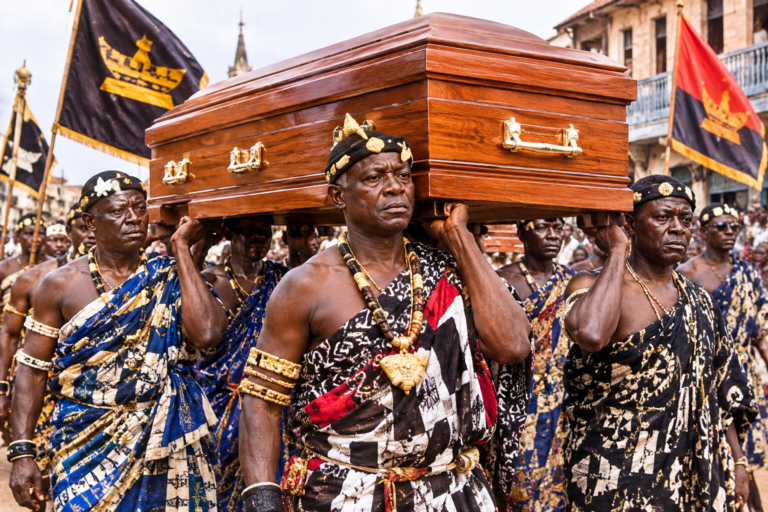
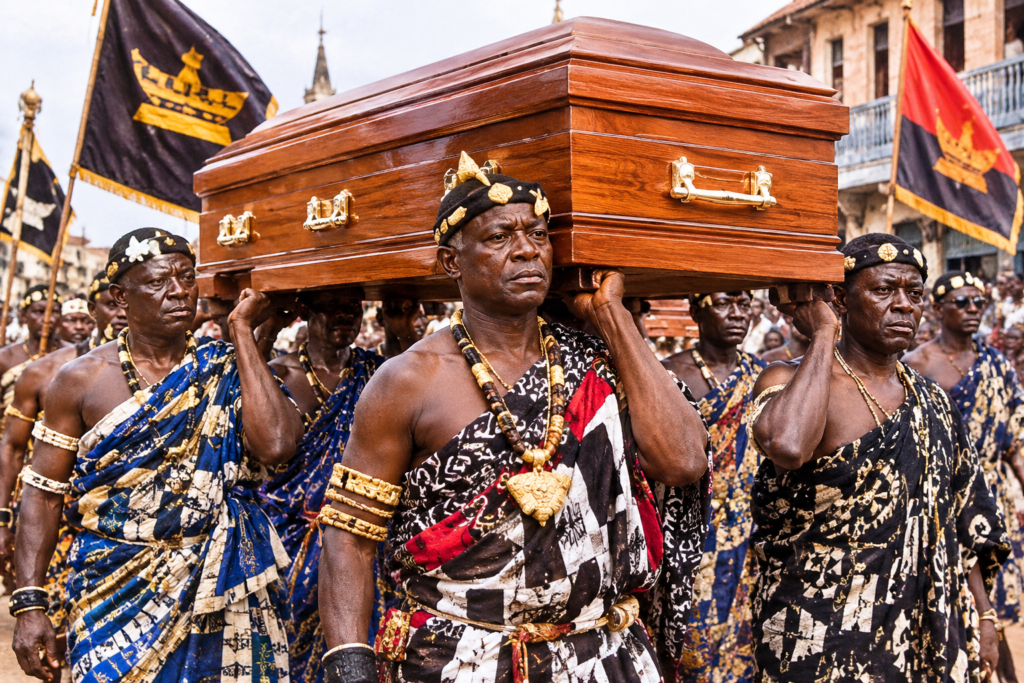
In many Ga royal houses, including Ga Mashie, La, Nungua, Teshie and Osu, public mourning is separated from restricted interment. The community sees the procession, the lying in state, the public casket and the mourning rites. The actual burial may be known only to a few designated elders, priests and royals. Where an empty or substitute coffin is used, it is a recognised ritual response, not a mistake and not an outsider’s assumption.
The royal body, especially the head, is treated as sacred and ritually potent. In Ga and wider Ga Dangme ontology, the chief’s office, the community’s relationship to the ancestors and the ritual person of the ruler are not reducible to a public corpse. The remains must be protected from desecration, theft, decapitation, ritual misuse and political humiliation.
Enemies or rival claimants may steal a body or head to claim victory, capture ritual power, use remains in ritual medicine, or block proper ancestorhood and succession.
An empty or ceremonial coffin therefore performs several customary functions. It offers protection by misleading potential desecrators while the real interment is concealed. It allows ritual completion by enabling the community to perform mourning and funeral rites even when the body is unavailable, stolen, contested or deliberately hidden. It supports succession security by keeping the grave and ritual sequence out of the hands of rivals during a disputed succession. It preserves royal dignity and taboo by maintaining the separation between public mourning and sacred interment. It also provides social closure by giving the community a real ceremonial focus, not a fake funeral but a valid ritual object carrying the office and the people’s relationship to the chief.
Current Ga chieftaincy impasses often involve rival claimants, court injunctions, police and morgue custody disputes, contested funeral committees and public accusations about who controls the body and the grave. In that environment, an empty or ceremonial public coffin is not irrational. It is a protective strategy. It allows the accredited royal house to perform public rites without surrendering the real remains to opponents, without exposing the grave to desecration and without allowing the funeral to become a political trophy. The public casket lets the community mourn. The secret interment protects the stool, the ancestors and the succession.
Ga Mashie royal houses have public lying in state and procession with a casket, while actual interment is restricted to selected elders, priests and royals at a protected site. The public casket is ceremonial and the real burial is controlled. La, Nungua, Teshie and Osu royal funerals show a separation of public mourning from restricted burial and the use of substitute rites when the body is unavailable, contested or must be hidden. These are Ga states with distinct royal houses, and the pattern illustrates the customary logic. Historical chieftaincy conflicts in Ghana include reported cases of body theft, grave robbery and decapitation, which show exactly why royal remains are concealed and why a decoy or empty coffin can be customary. Current Ga Mantse succession disputes, with public funeral claims and counterclaims, demonstrate why royal houses separate public ceremony from restricted custody of the body and grave. A ceremonial casket allows rites to proceed while the real remains and burial site remain protected.
The empty coffin, where Ga royal custom invokes it, is not an assumption. It is a customary instrument of protection, ritual completion, succession security and royal dignity. In current Ga impasses, it defends the stool from desecration and political capture. Critics who demand that the public casket contain the real body are demanding that custom submit to forensic exposure, precisely what the custom exists to prevent. Ga kings and queens are not buried in an empty coffin because the royal house is guessing. They are buried according to a protected ritual logic in which the public coffin and the real interment need not be the same. That is custom, not assumption, and it deserves to be defended as such.
Venerable Dr. Nathaniel Nii Naate Atswele Agbo Nartey, Th.D., Ph.D.
Journalist · Culturist · Biblical Psychologist · Christian Educationist · Community Support Specialist