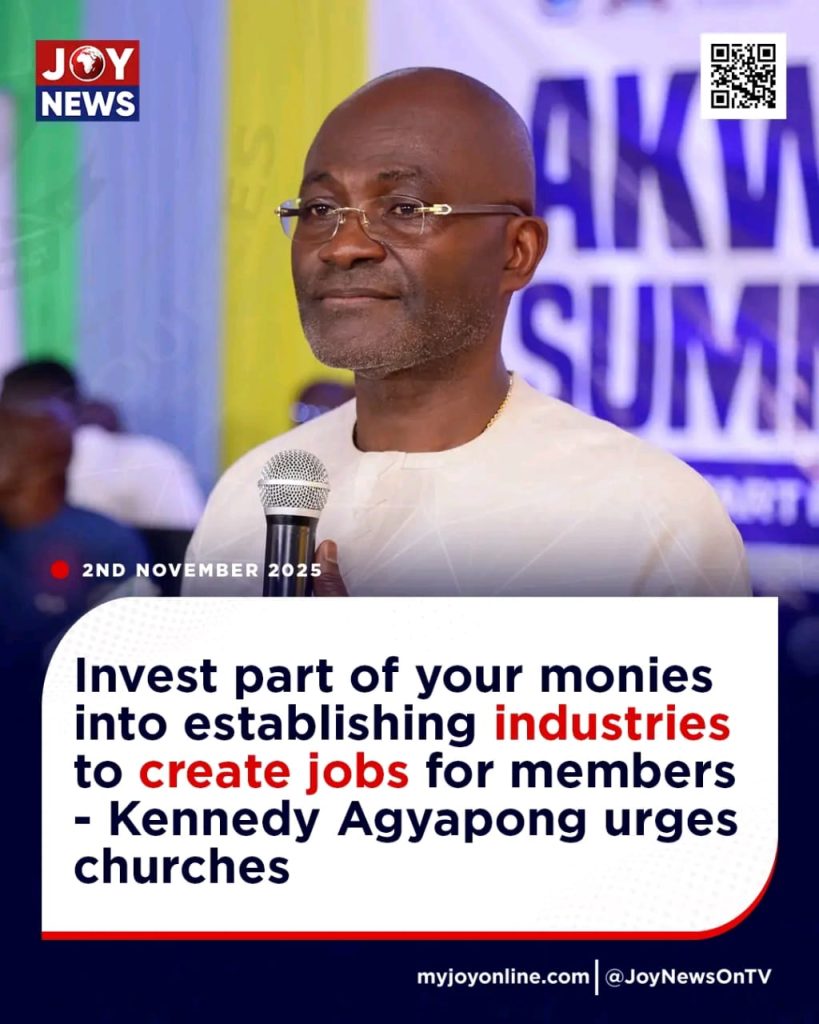
Kennedy Agyapong’s recent advice to churches that they should invest part of their monies into building industries and factories to create jobs for members, may sound clever to the casual listener, but it is deeply flawed and impractical from both a theological and church’s administrative standpoint.
The church is not a profit-making institution. Its mission is not commerce but compassion, what in church practice is called Operation Andrew: relief, charity, and social upliftment. To demand that the church functions like a business enterprise reflects a carnal mindset, one that measures success by profit rather than purpose.
From a theological–economic perspective, Kennedy Agyapong’s proposal represents worldly wisdom masquerading as insight. It completely ignores the spiritual mission and operational reality of the church. The church exists to be the moral and social foundation of society, feeding the hungry, healing the sick, educating the young, and guiding souls. It is this work that sustains the very social environment in which entrepreneurs like Kennedy Agyapong thrive.
The church’s primary calling is spiritual ministry, pastoral care, and social welfare, not factory management or industrial engineering. Building schools and hospitals are natural extensions of its biblical duty to serve “the least of these.” But setting up a factory requires enormous capital investment, technical expertise, and exposure to market risks that most churches are neither equipped nor called to handle.
Unlike education or healthcare, which directly serve the community even in financial difficulty, manufacturing ventures can collapse under mismanagement, leaving behind debt, scandal, and a damaged reputation. Kennedy Agyapong himself once accused Pastor Dr. Mensa Otabil of corruption during the Capital Bank saga, an example of how business entanglements can taint the church’s spiritual integrity.
Moreover, the idea of employing only church members in such industries is both inefficient and exclusionary. It elevates religious affiliation over competence, a sure path to failure. The church’s true witness is in inclusivity: a mission hospital or school serves everyone, regardless of faith, thereby building goodwill and genuine social capital.
Churches already have a proven track record in nation-building through mission schools, hospitals, food aid, and shelters. These initiatives may not yield financial profit, but their social return on investment is immeasurable. They cultivate a literate, healthy, and morally grounded citizenry, the very bedrock of sustainable economic growth.
While a few mega-churches may have the capacity to operate businesses, the vast majority do not. Their strength lies not in industrial competition but in building stable, compassionate, and spiritually sound communities, without which no economy can stand.
A wiser approach would be for churches to empower and mentor entrepreneurial members, providing moral guidance, ethical leadership, and community support, rather than attempting to run industries themselves. The church’s calling is divine, not corporate.
Kennedy Agyapong’s advice, though well-intentioned, is ultimately carnal, a worldly prescription for a spiritual institution. The Church of God does not draw its strength from machinery or markets, but from faith, compassion, and truth.
By: Osɔfo Nii Naate Atswele Agbo Nartey