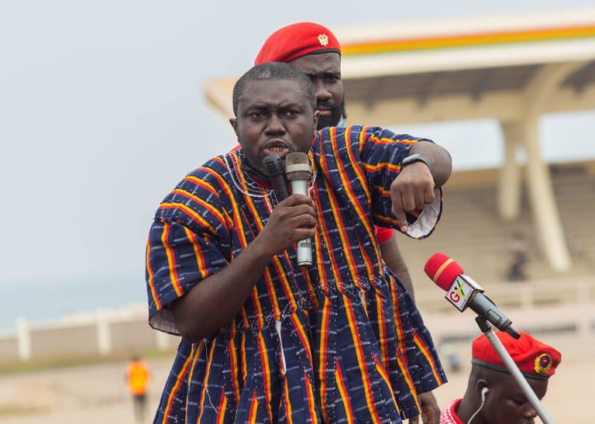
Oliver Barker-Vormawor, the Convener of the Fix The Country Movement and a member of the Ghana Bar Association (GBA), has issued a strong rebuke of the Association’s recent resolution that contests the President’s suspension of the Chief Justice. During an appearance on TV3’s KeyPoints, he characterized the resolution as politically charged and aimed more at shaping public sentiment than at upholding the tenets of justice.
Vormawor contended that the resolution is fundamentally flawed, describing it as “an appeal cloaked in impropriety.” He criticized its language for failing to adhere to the standards of a valid legal challenge and for unjustly suggesting misconduct on the part of the President, despite established precedents set by the Supreme Court.
He urged his colleagues within the GBA to convene a special general assembly to reverse what he deems a reckless decision. “History will not forgive us if we let this slide. Internationally and domestically, this resolution could be misinterpreted as a condemnation of the judiciary’s independence — and that’s perilous,” he cautioned on May 3. He emphasized that the GBA is disregarding settled legal precedents and injecting political bias into a legal matter, insisting that constitutional interpretations should be anchored in established legal principles rather than emotional responses.
In a related critique, Godwin Edudzi Tameklo, CEO of the National Petroleum Authority, accused the GBA of “manifest hypocrisy” regarding its recent commentary on judicial appointments.
Tameklo pointed out that the GBA’s current position on the nomination of new Supreme Court judges is inconsistent with its stance in 2023, when it was under a different Chief Justice. He questioned whether the GBA had conveniently overlooked or intentionally ignored the events of the previous year, when a similar appointment process took place under a different administration.
“Is the bar telling me that in 2023, when this circular came, they were not aware? Or were they deeply asleep and are just now waking up?” he asked rhetorically. “Let’s be fair. We are building a democracy that should inherently reflect fairness.”
He referenced the appointment of Justices Yaw Appau and Gabriel Pwamang to the Supreme Court by then-President John Mahama, noting that the Judicial Council had recommended four candidates and ranked them. Despite this, President Mahama chose the second and fourth-ranked individuals, a decision that drew significant criticism from the GBA, led at the time by Nene Amegatcher.
“The bar asserted that since the Judicial Council had made recommendations, the President was obligated to choose from the top four candidates. Thus, he had no right to select the fourth and second-ranked individuals,” he recalled.
Tameklo further highlighted that the GBA even pursued legal action against President Mahama’s decision in the Supreme Court, questioning why the Association’s concerns only seem to surface when Mahama is the one making appointments. “How come the bar is only vocal when President Mahama is the one acting?” he queried.